Your salary is fixed — your hours are not. WorkWize is the unpaid overtime tracker that turns your real work hours into your true hourly wage, so you can see exactly how much free work you're giving away.
Free on iPhone · Private, on-device tracking · Built for salaried professionals
Inside the App
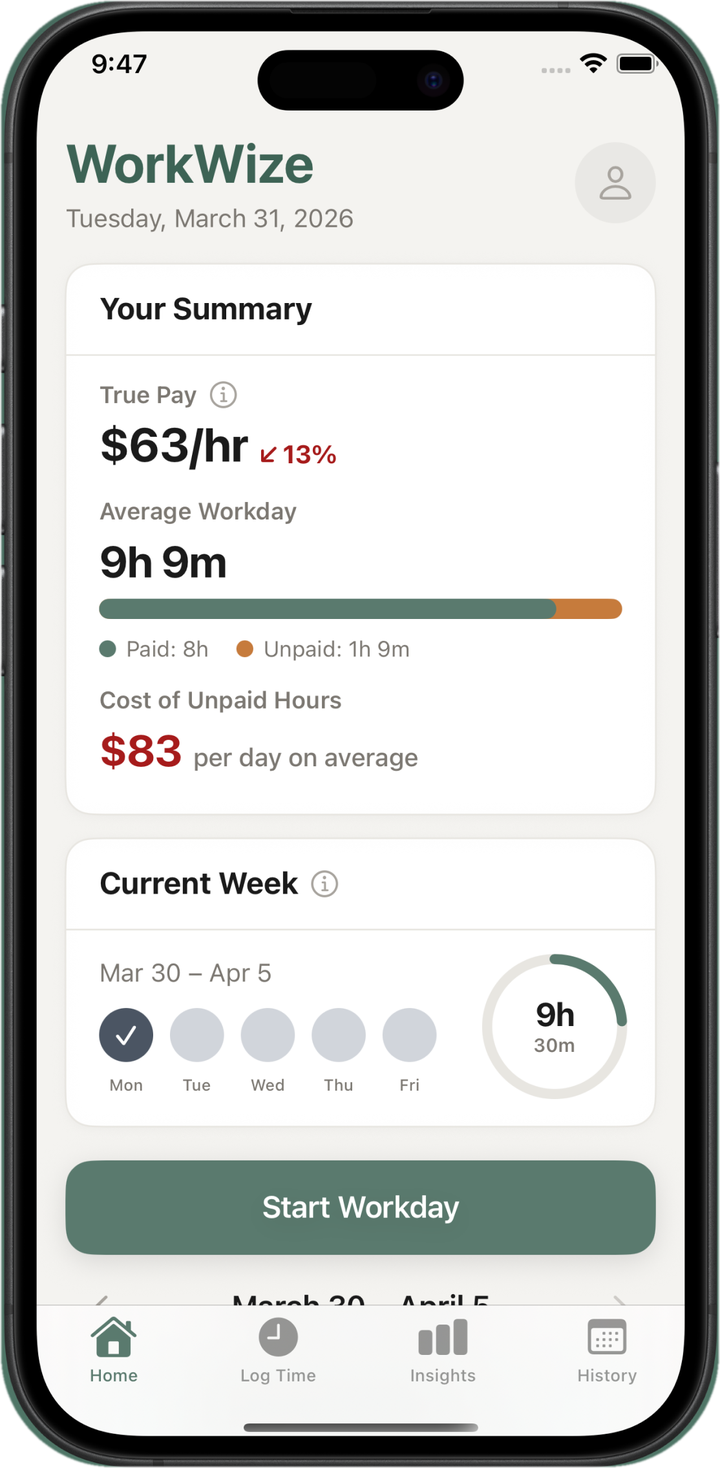
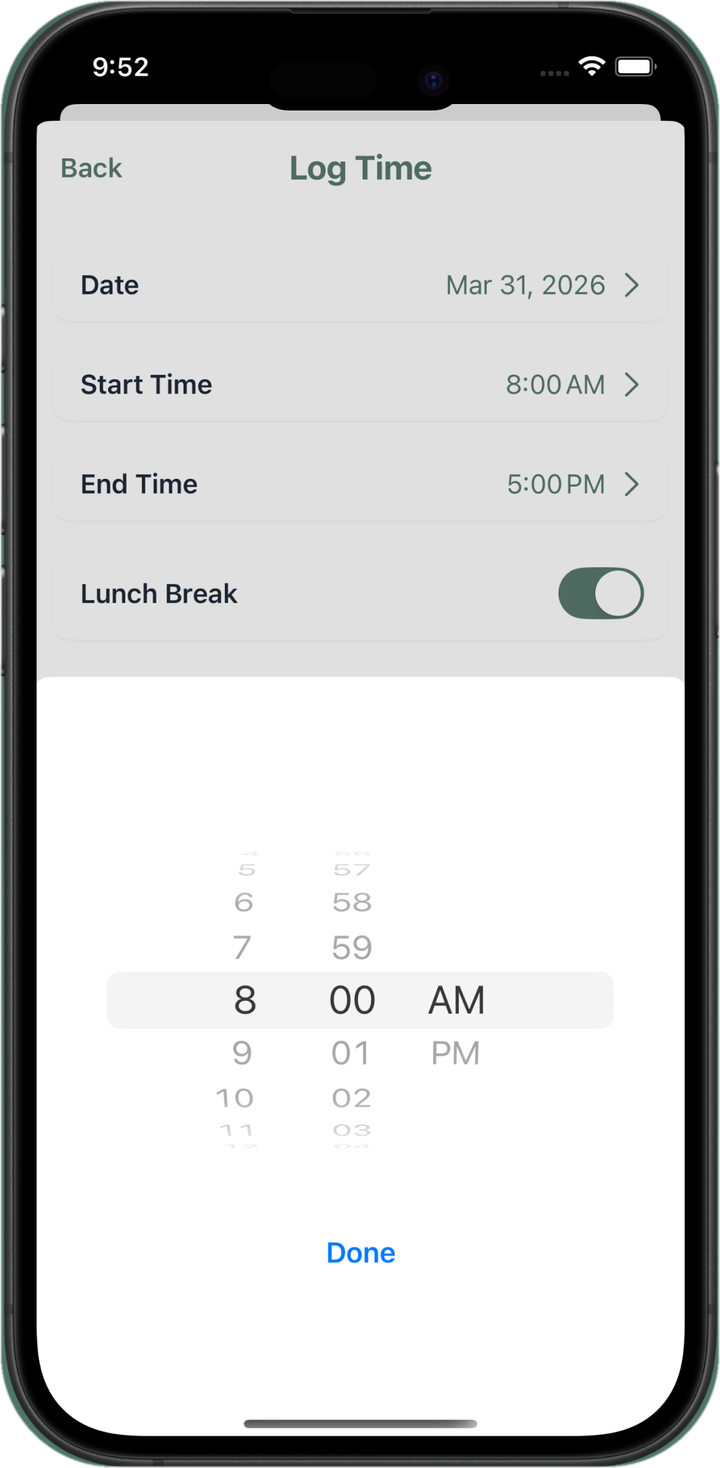
Every screen is built to answer one question: what is your time actually worth? Log your workday in seconds and WorkWize turns it into pay insights you can act on.
How It Works
No timesheets, no billing codes, no employer involvement. WorkWize is a personal work hours tracker for salaried employees — your data stays yours.
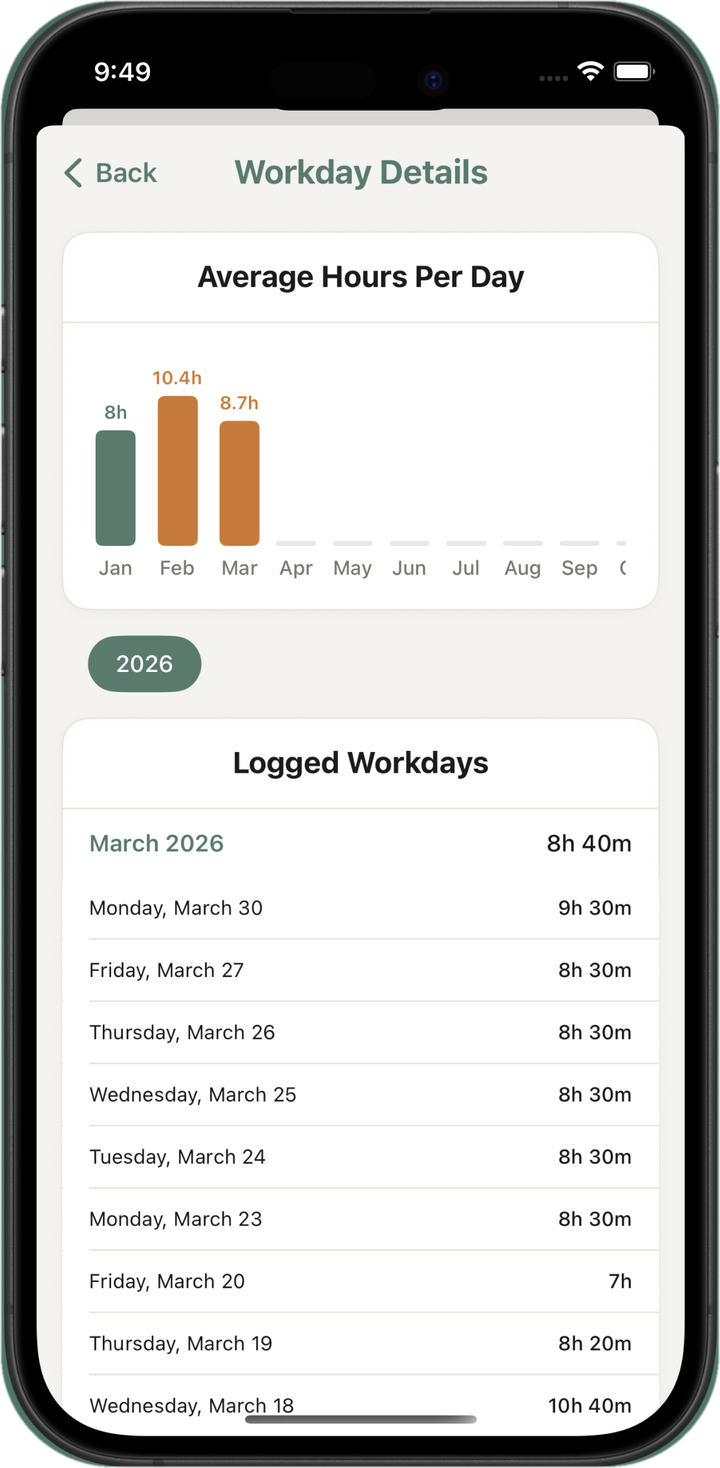
Tap Start Workday when you begin and end it when you truly log off — including the late nights and weekend check-ins. Add your lunch break with one toggle.
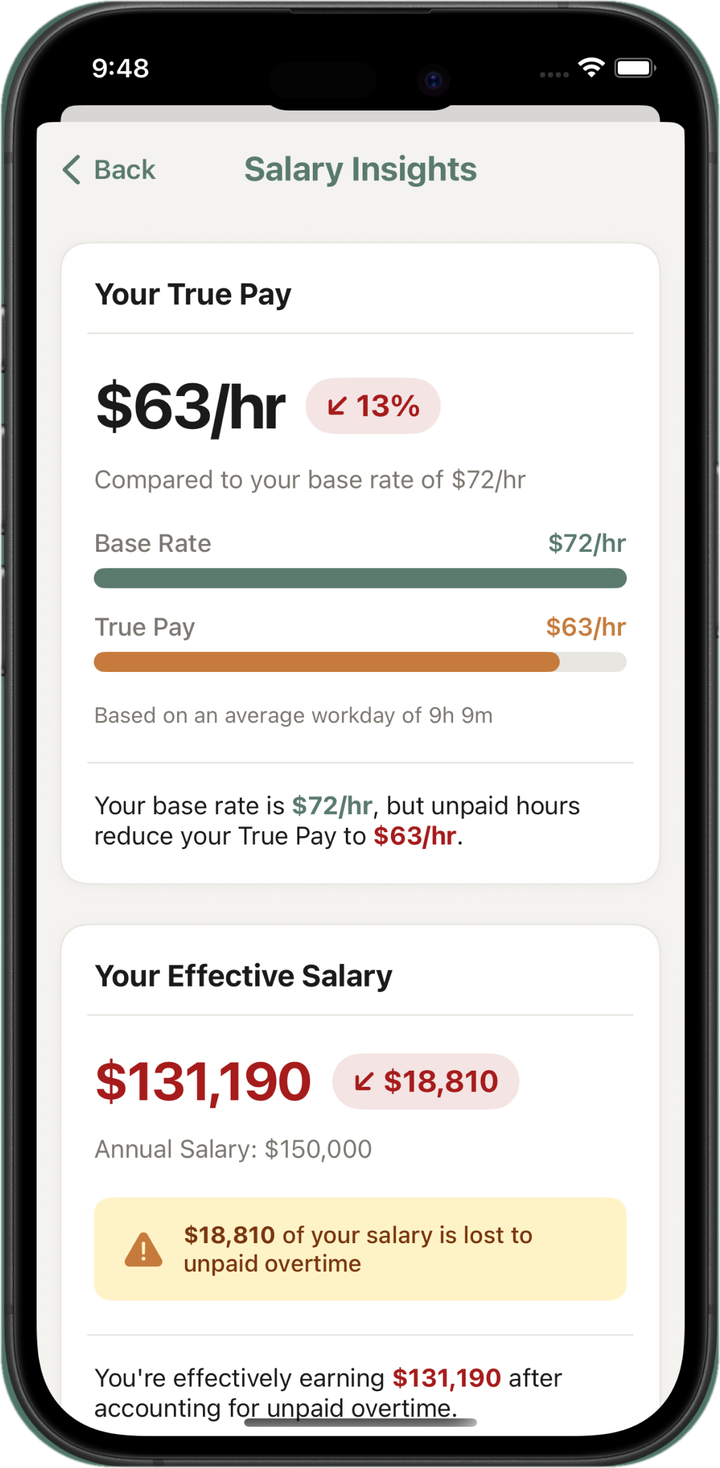
WorkWize compares your base hourly rate to your true hourly wage based on the hours you actually work, and shows your effective salary after unpaid overtime.
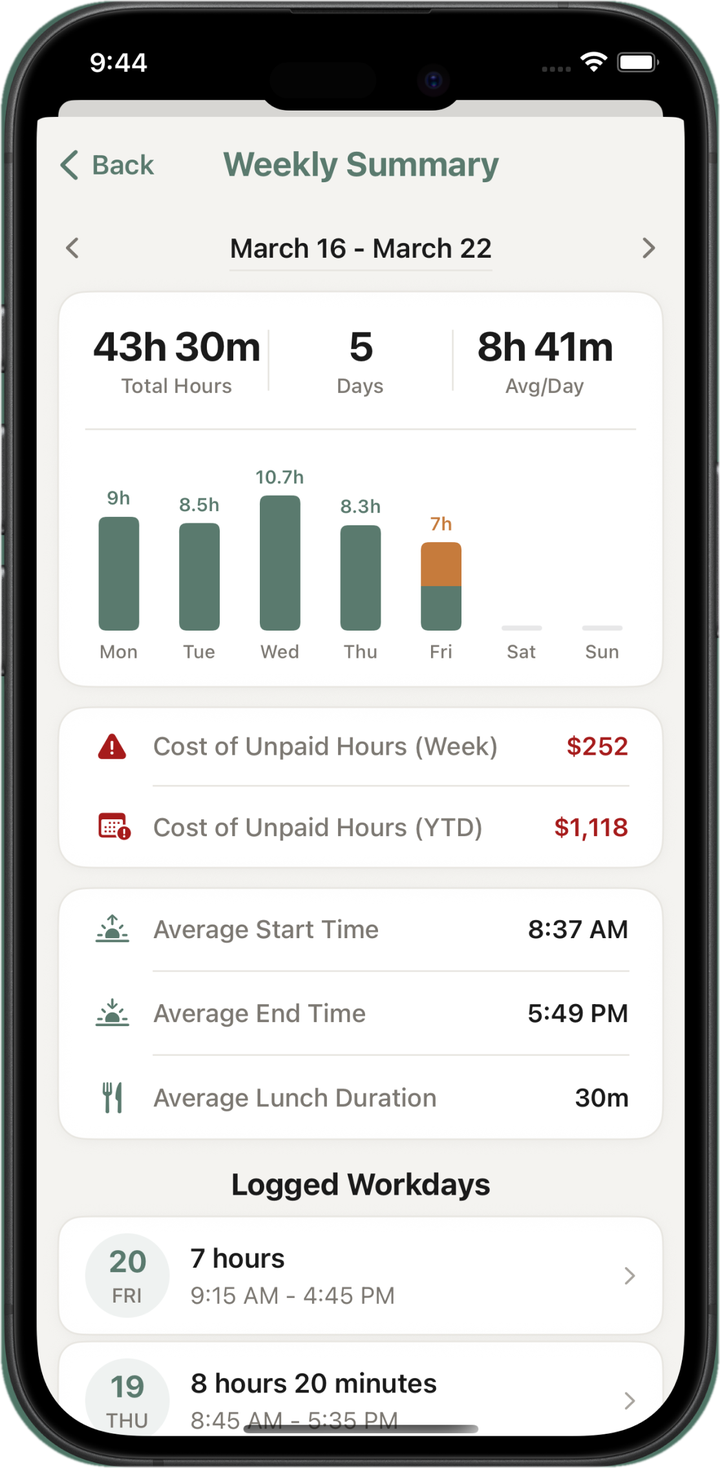
Use daily, weekly, and year-to-date cost-of-unpaid-hours figures to set boundaries, negotiate workload or pay, and catch overwork before it becomes burnout.
Free Tool
Enter your salary and real weekly hours to see your true hourly wage and what unpaid overtime is costing you each year. Then track it automatically with the app.
Based on 52 working weeks. Your real number depends on the hours you actually log — that's what WorkWize tracks for you.

Guides
Practical, no-fluff guides on unpaid overtime, true pay, and protecting your time as a salaried professional.
The simple formula that reveals what your salary is really paying you per hour — and why the standard ÷2080 math is almost always wrong.
Read the guide →A salaried employee's system for documenting extra hours — what to record, how often, and how to make it a 10-second daily habit.
Read the guide →Exempt vs. non-exempt explained in plain English — and what to do if your overtime is legal but still costing you thousands.
Read the guide →Put a real dollar figure on your late nights: the math, worked examples by salary level, and how to track your number automatically.
Read the guide →Seven measurable warning signs of overwork and early burnout — and the workload data that confirms whether it's a bad week or a bad trend.
Read the guide →A script and data checklist for raising "I'm working too many hours" without sounding like a complaint — evidence first, ask second.
Read the guide →How to convert your annual salary to an hourly rate using your actual hours, with a table of common salaries at 40, 45, 50, and 55 hours.
Read the guide →Boundary-setting tactics that work for salaried employees — without torching your reputation. Backed by your own hours data.
Read the guide →FAQ
Quick answers to the questions salaried professionals ask most about extra hours, true pay, and tracking their time.
Unpaid overtime is any time you work beyond your standard scheduled hours without additional pay — staying late, logging on over the weekend, or working through lunch. For salaried employees classified as exempt, these hours are usually legal, but they still carry a real cost: every unpaid hour quietly lowers your effective hourly rate. Learn more about the cost of unpaid overtime →
Divide your total pay by the hours you actually work, not the hours on your contract. A $150,000 salary at 40 hours a week is about $72/hr — but if your real average is 46 hours, your true hourly wage is closer to $63/hr. Learn more about calculating your true hourly wage →
Only if they're classified as non-exempt under the FLSA. Exempt employees — most executive, administrative, and professional roles above the federal salary threshold — are not entitled to overtime pay, no matter how many hours they work. That's exactly why measuring the cost of those hours matters. Learn more about salaried overtime rules →
Record your start time, end time, and lunch break every workday. With WorkWize it's a 10-second habit: tap Start Workday in the morning and end it when you truly log off. The app builds your daily, weekly, and yearly picture automatically. Learn more about tracking unpaid overtime →
Multiply your base hourly rate by your unpaid hours. One extra unpaid hour per day at a $72/hr base rate is roughly $18,800 per year in free work. Try the unpaid overtime calculator above, or learn how the math works →
Rising average workdays, shrinking lunch breaks, regular weekend log-ons, and a widening gap between your base rate and true pay are the measurable ones. Persistent exhaustion, irritability, and Sunday dread are the felt ones. Learn more about the warning signs of overwork →
Lead with data: your average workday, your weekly totals, and the trend over time. A documented pattern turns "I feel overloaded" into "my average workday has been 9+ hours for three months" — a conversation managers can actually act on. Learn more about the workload conversation →
Yes — WorkWize is free to download on the App Store, and your hours are logged privately on your device. No employer accounts, no monitoring, no timesheet approvals. It's your personal record. Get WorkWize on the App Store →

Every unpaid hour you don't track is an hour you can't get paid, credited, or respected for. Start logging today — your first insight takes one workday.